
Blog
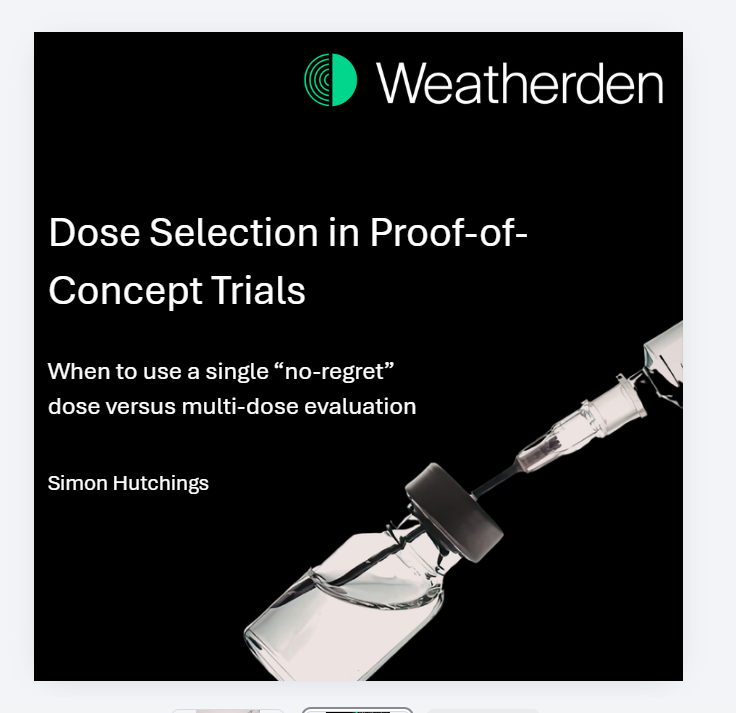
Dose Selection in Proof-of-Concept Trials: When to use a single “no regret” dose versus multi-dose evaluation
Our latest white paper, by Senior Clinical Pharmacologist Dr Simon Hutchings, looks at one of the most important decisions in early development: whether to back a single “no-regret” dose or generate evidence across multiple doses first.
The paper explores how dose strategy shapes interpretability, regulatory confidence, and programme risk, with examples from Alzheimer’s disease, oncology, and adaptive trial design.

From AI novice and skeptic… to AI novice
From AI sceptic to cautious adopter, this blog cuts through the hype to explore where AI genuinely helps regulatory professionals—and where human judgement remains non‑negotiable.

Meet the Expert: Statistics
We’re thrilled to spotlight two of Weatherden’s brightest minds in our latest #MeetTheExperts blog: Andy Grieve and Margaret Jones – Industry veterans and pioneers of Baysian and adaptive trial designs.
Why you’ll want to read:
Get Andy’s take on overcoming resistance to Bayesian methods, and why the skeptics are now converts.
Learn Margaret’s playbook for designing nimble, data-driven development plans that flex to real-world results.
See concrete examples of how adaptive trials are changing the game for patients and sponsors alike.

Dose Matters: Navigating FDA Guidance for Oncology Drug Development
For the last few years the FDA has been engaging with drug developers to reform how dose optimisation is approached for new cancer drugs. In August 2024 they finalised the eagerly-awaited guidance for industry. As part of our collaboration, Weatherden and Physiomics have worked together to help you understand and put this framework into action.

Why do drugs fail? Why success rates haven’t improved for over a decade
Despite significant advances in biology, chemistry, and drug development platforms, drug attrition rates have remained stagnant in recent years. Dr Duncan McHale, co-founder of Weatherden, explores some of the ways big pharma has tried to tackle this problem – and why they’ve largely fallen short.

>200 companies
We have advised, worked with and supported dozens of funds and biotechs.

>500 million plus
Our input is benefitting patient populations worldwide.

>25 billion USD
Our repeat and long-term clients have realised significant value gains since we became involved in their programmes.